
I settled on “The 12 Days of Testing” as the inspiration for my Christmas 2023 post. It started out fine, but frankly, where do you go after you’ve written
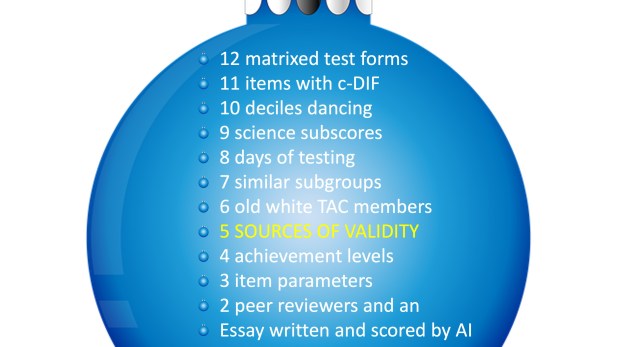
So, I decided to go in a slightly different direction. I would offer up my own grown-up Assessment Christmas List. A list that would lay out my vision for what would be contained in the mythical fair and balanced assessment system that is mentioned quite often by assessment pundits (friend and foe alike), rarely described in more than vague generalities, and as of this writing, yet to be discovered in the wild or created in a laboratory setting.
But I still couldn’t shake off the number 12. It seems to work pretty well for organizing things.
All of which is a long way of introducing my 2023 Christmas offering to you: my wish list for the components of a comprehensive, balanced, and fair assessment system; organized around the number 12, mostly conveniently and serendipitously, but sometimes a little awkwardly.
12 years of testing
What are the BIG assessment pieces I would schedule across a student’s roughly 12 years in public education?
At the school level, my Christmas list includes a few NAEP-like assessments at key transition points in a student’s educational career. My final administration is probably at the end of eighth grade. That’s close enough to the end of the foundational “common core” of knowledge, skills, competencies, etc. that apply universally and fairly uniformly to all students. And there are better ways than a large-scale test to evaluate schools and schooling at the end of high school.
You might be able to talk me into early 10th grade if you want to find a way to include ninth grade skills in the mix, but end of eighth grade is a pretty definitive transition point on a number of levels.
Fourth grade is fine for an early administration, coming at the end of primary school and prior to the start of middle school. Assessing reading closer to the end of third grade is not out of the question. I’m still a fan of a sixth grade mathematics assessment. Too much is happening in mathematics between fourth and eighth grade for us to let that go unassessed and under-understood. (Efforts to smooth out achievement level results in mathematics across grades 4 through 8 for accountability purposes might be one of the most significant and least talked about negative unintended consequences of NCLB. Coal in the stockings of those of us who let that happen!)
At the student level, I am looking for capstone projects at major transition points such as the end of elementary school, the end of middle school, and the end of high school. They will be interdisciplinary in nature but may be housed within a particular content area at the elementary and middle school level.
I see the content being pretty uniform at the elementary school level, the content area being broadly uniform at the end of middle school (e.g., civics, government, citizenship, US history) with lots of room for student choice of a particular focus topic. The project at the end of high school (whenever that may be) is connected to the student’s area of specialization, interest, and perhaps postsecondary plans.
12 months
Across 12 months, I am sticking with large-scale assessment instruments and focusing my wish on making good use of traditional interim assessments administered three or four times per year and used for traditional purposes: progress monitoring and growth. A key to their utility is a solid approach to computing and representing growth at the group and individual student level.
At the system, or aggregate, level, these tests are best used to monitor and evaluate progress across classrooms, teachers, or schools. Is there a particular group that seems to be well ahead of the others or one that is falling behind? If so, it’s time to dig a little deeper to find out why – something often accomplished well in an informal setting with some good data and some good conversation.
The focus really is the same at the individual student level, with the understanding that there is going to be a lot more noise associated with a single test score for an individual student.
These tests may be developed by the state and their assessment contractor, or they may be commercial tests vetted by the state. The tests will be aligned to the state’s content and achievement standards. The most useful design for these purposes will be the use of the full test blueprint at each administration, but alternative designs can be considered.
Information from some, or all, but at least the final, test administration each school year may be used as part of the state’s assessment program.
12 weeks
At 12 weeks, my wish is for performance events or tasks – one task per trimester assessing “big” competencies and cumulative skills, the first two building toward a final project and presentation at the end of the year.
Each task may be housed within a particular course or content area, but by nature and design the skills that they assess will be interdisciplinary.
The tasks within a year may be split across content areas.
Ideally, the tasks across years will be designed to build the foundational skills necessary to prepare students to successfully engage in the capstone project at the end of elementary, middle, and high school.
My wish is for these performance events eventually to be state supported. Whether and how any or all of them might factor into a state’s through-year assessment system or might be used as part of a state’s accountability system can remain an open question for now.
The most important first step is to get them up and running and integrated into school curriculum and instruction. Accountability and other potential uses can come later.
As much as we might frown on attempting to retrofit assessments for purposes such as accountability, decades of experience with so-called “performance tasks” have shown us the disheartening, actually soul-deadening products that are built when accountability is the driving force behind the design, development, and administration of performance events.
Part 2 – Diving Deeper Into the Classroom
When we get down to the level of days, the focus of my wish list begins to shift away from the whole to the parts, and from the “health” of the system to the instruction and learning taking place in the classroom with individual students.
12 days
At 12 days, I am asking teachers and students to think about the assessment that will take place during a typical 2-3 week unit of instruction. How will you monitor how well the student is progressing through the unit and how will you determine whether the student has mastered the content/skill, met expectations, or acquired the desired competency?
- What are the critical assessment moments that will occur during the course of instruction?
- Which components will be teacher-developed, which ready-made, and which, perhaps a hybrid?
- What will the summative test, task, event entail?
12 hours
My assessment wish at 12 hours is for a mindset that fosters self-awareness and continuous self-reflection on the part of the teacher and the student.
- What parts of the lesson went well today and what were the rough spots?
- What material do I need to review and what questions do I need to ask tomorrow – and to whom?
- What’s coming next and what adjustments, if any, do I need to make to my original instructional or learning plan?
12 minutes
It was 1970 when I picked up a copy of the paperback “the new aerobics” by Dr. Kenneth Cooper and learned of Cooper’s 12-minute run test of aerobic fitness. [At the time, I was doing a mile in under 6 minutes. Those were the days. A different time and a different wish list.]
Fifteen years later, working with Stan Deno at the University of Minnesota I learned of curriculum-based measurement (CBM) and even shorter, calibrated probes of students’ academic vital signs in key skill areas such as writing, spelling, reading comprehension, and mathematics.
Both of these examples are centered on short, highly reliable, easy-to-administer tests which can be used repeatedly and frequently to monitor student progress toward an ultimate skill or desired outcome.
Since that time, I have been convinced that frequent, measurable, and observable progress toward a goal is a requirement for long-term success in reaching that goal. I have stepped on enough scales in my lifetime, however, to know that measurement alone is not sufficient. The instructional principle here is simple. If the student is not making adequate progress toward the goal, a change in the current instructional approach is needed. The process does require teachers to have the wherewithal to adjust instruction – wherewithal, a really nice word.
Such teacher-administered probes will be a core component of my wished-for assessment system, particularly in the early grades and particularly in areas with well-defined skills that students build over time. Perhaps even some of those other skills we’ve never addressed or assessed. I can dream can’t I – it’s a Christmas list, after all.
12 seconds
Throughout a child’s career in education, from early childhood through graduate school, if that is the path they chose to follow, I am looking for 12-second check-ins. These are the little balance checks that lead to calibration, fine-tuning, and adjustments, if necessary, or let you know that you are on the right path.
These checks can be initiated by either the instructor or the student. Checks initiated by the teacher may be preplanned and somewhat formal like exit slips or lesson warm-ups like the one shown in the popular “My Favorite No” video (which I first saw years ago, shared by my friend and former co-worker Karin Hess, who offers invaluable advice and techniques of her own).
Or they may be informal, such as when the teacher pauses the lesson to check-in on student understanding. One of my professors was a master at knowing when to pause and what and who to ask.
Similarly, students should feel comfortable with and become accustomed to asking the teacher, a peer, their virtual assistant, or themselves questions periodically to check their own understanding.
A dream is a wish your heart makes…
There you have it. My Christmas vision of the components of a comprehensive, balanced, and fair assessment system.
Batteries not included. Some assembly required. Like many recipes, lots of advanced prep work is needed before we actually start cooking.
But all of the pieces are there. It’s real. It’s tangible. It’s safe to believe in it.
And oh, what fun we’ll all have playing with it when it’s up and running.
Merry Christmas and Best Wishes for 2024.
Image by Gerd Altmann from Pixabay
 Embrace the Absurd
You must be logged in to post a comment.