
There is an appointed time for everything,
And a time for every affair under the heavens.
A time to give birth, and a time to die;
a time to plant, and a time to uproot the plant.
A time to kill, and a time to heal;
a time to tear down, and a time to build.
A time to weep, and a time to laugh;
a time to mourn, and a time to dance.
I’ve written posts about my father and mother and all of the important life lessons I learned from them. But it was my Uncle Sal who took me to my first James Bond movie at the majestic 3,600-seat Music Hall in Boston – entering through the stage door because he knew a guy. About 15 years later we saw Frank Sinatra and Dean Martin perform there – tickets were hard to come by, but I knew a guy. He took me hunting and taught me how to identify and pick the good mushrooms (that is, the ones that wouldn’t kill you). Neither of those lessons stuck, although the mushroom knowledge would be useful here in Maine.
And he taught me about football. We didn’t have a history of professional football here in Boston – the Patriots and I were born the same year, but he told me stories of his adopted Baltimore Colts and Johnny Unitas with his high top cleats.
When I was old enough, we sat high in the grandstands along the first base line at Fenway Park watching plays unfold at some Boston Patriots games in the 1960s – yes, football at Fenway. I learned that field-level might be great for hearing and feeling a football game, but a higher vantage point was the prime spot for watching and learning football. And I learned that you should always carry a flask to games when the weather turned cold.
We parked in Cleveland Circle and made the walk around the Reservoir to watch football games at Boston College on a Saturday or Sunday afternoon, the same walk that my daughter made on a daily basis the last two years from her apartment to her postdoc position at BC.
In the 1970s, he took me to a couple of Patriots games at the new Schaefer Stadium in Foxboro, again parking about a mile away from the stadium. Life lessons.
(Eventually, they tore that stadium down and built Gillette Stadium next to it. I have been to about a half dozen Taylor Swift concerts there, but I hear that they also use it for football in the fall.)
My own experience playing football growing up was limited to touch football on the side street across from our house. My career highlight – holding onto the ball while catching an over-the-shoulder pass and simultaneously running full speed into the back of a parked car. And it was a big, heavy, American car of the 1960s, the kind that you could sit on while hanging out with your friends. My role at football games in high school and college was playing clarinet in the band.
Uncle Sal got me summer jobs in high school and college working on the day cleaning crew, first at high-rise office buildings in downtown Boston, and then at the Design School at Harvard. You learn a lot about people (and yourself) spending the summer operating a freight elevator and cleaning and restocking 33 floors worth of restrooms after lunch each day.
Uncle Sal, the older brother, my godfather, relished his role as the patriarch of our little extended family, the stereotypical Italian-American head of the family, the godfather – a role he learned from his grandfather. When he arrived, whether for an unannounced visit after Mass on a Sunday morning or for a holiday dinner, my father would bring out a juice glass and the bottle of Seagram’s 7 kept on hand just for him. Uncle Sal would hold court. The stories would begin.
As the bottles of whiskey emptied and as years passed, the details changed, and the stories were embellished. The story of the train passing by as a squad of soldiers relieved themselves on the side of the road after marching in Harry Truman’s Inaugural Parade became a platoon and then a battalion with the train stopping as a mix of horrified and amused passengers looked on. The story of the contract negotiations as union president at the local shoe factory became more intense and included dire warnings from my uncle of the Pyrrhic Victory in the union winning a contract that would ultimately price its members out of jobs. The stories of my father’s exploits when they were both stationed in Germany during the Korean War became wilder when my father was no longer around to counter them.
But of all the stories, the ones he loved to come back to time and time again were those of his own days playing football. And of all of those stories, it was the tale of the Park League championship game that he told most often. There he was, in a borrowed white football helmet, a boy among men, running over and through people, stiff arming a defender as he ran down the sidelines, the crowd cheering wildly, … It even made the newspapers. Glory Days.
Hearing the story for the first time as a young boy, I was duly enthralled, impressed, and inspired. As a young man, I smiled as the familiar events unfolded. Hearing it again last Christmas from a 93-year-old man with little left but his stories, I nodded along and wondered what actually happened that day. And I thought about my own stories, including those shared via this blog.
After Uncle Sal passed this summer, I was trying to retell his story but couldn’t remember the name of the team. An online search for information about Boston Park League Football back in the day not only jogged my memory on the name of the team, but also revealed a Facebook page commemorating the history of the league and its teams. And there on the South Boston Chippewas page was the image of a 1951 sports page with a grainy photo of the halfback in the white helmet in that classic Heisman pose. The story described the championship game, a 7-7 tie that played out in front of 18,000 fans, the largest crowd ever to attend a game in the Fens.
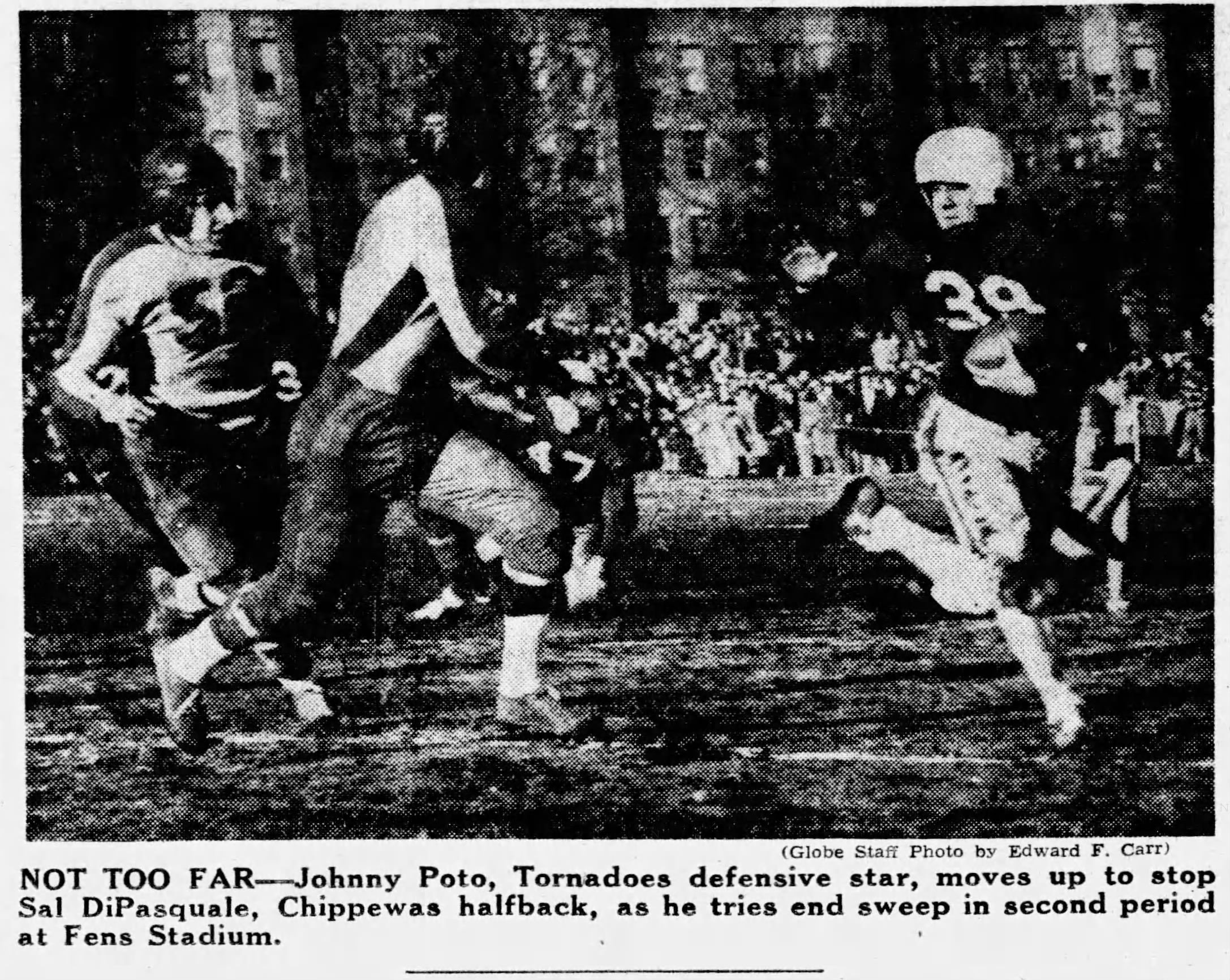
Sure, they got the spelling of our name wrong, but that didn’t matter, so did about half of our relatives, even those on my father’s side of the family.
All that mattered was there he was, young, alive, and frozen in time. He and his story live on.
As they say, number 38 (or 39) in the program, number one in my heart.
 Embrace the Absurd
You must be logged in to post a comment.