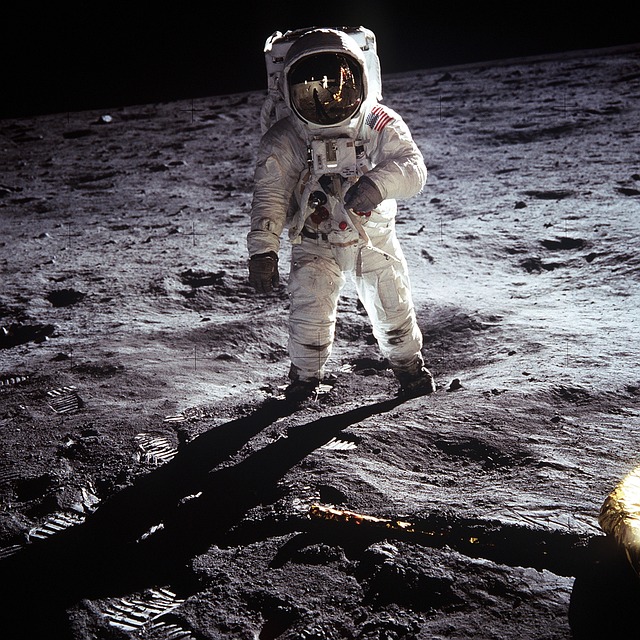
As part of my annual celebration of the July 1969 Apollo 11 moon landing, I decided to read James Hansen’s 2005 biography, First Man – The Life of Neil A. Armstrong. Having failed in several attempts to stay awake while watching the 2018 film based on the book on Netflix, I nonetheless took on the massive 648-page tome (769, including end matter) with my eyes wide open, embracing those inspirational words of JFK: We choose to do these things not because they are easy, but because they are hard.
I started the book on launch day (July 16th) with the overly optimistic goal of finishing within the 8-day span of the original mission. Ultimately, I missed that July 24th deadline by a couple of days, but if there are two things I learned reading the book, they are that you have to flexible and you have to persevere – keep moving forward toward the goal.
While reading about Armstrong’s life and the space program that achieved its goal to land a man on the moon and return him safely to earth, my mind, as it tends to do, sought words of wisdom and lessons that could be applied to our own work in educational assessment and Education Reform. I came away with three takeaways:
- The Science Was Easy.
- The Engineering Was Hard.
- The Will Was Strong
And a bonus takeaway as part of the engineering point: the importance of understanding systems and modules.
The Science Was Easy
We often view the moon landing as a major scientific accomplishment – a milestone in the scientific fervor that was aroused by the namesake Sputnik moment in the fall of 1957. Turns out, however, that perspective is merely a reflection of our tendency to conflate science and technology, two subjects that are mysteries to many of us. Reading First Man, it became clear that the moon landing was much more a technological than scientific achievement. More accurately, Apollo 11 was the culmination of a series of technological achievements that enabled us to land men on the moon and return them safely to earth.
The science was all there in front of us. For centuries, we knew not only where the moon was, but also where it would be tomorrow, next week, next month. I’ll always remember that moment (long after 1969) when I realized that Apollo 11 and the moon had to arrive at the same place at the same time. If you’re a fan of Hidden Figures, no doubt you remember the breakthrough moment in the film when Katherine Johnson applies the Euler Method (old math from the 18th century) to solve the trajectory problem – leaving Sheldon Cooper slack-jawed in the background. We understood gravity on the earth and on the moon. We knew what was needed to escape earth’s gravity, enter into lunar orbit, and later to escape the moon’s gravitational pull. We knew the precise point when the Apollo command model would shift from racing away from the earth to falling toward the moon.
Relatively speaking, the science was easy.
The Engineering Was Hard
What we didn’t have, barely a half century since the Wright Brothers and Robert Goddard was the technology to get us from here to there. The Mercury, Gemini, and Apollo programs along with years of applied research that preceded them were devoted to designing, building, testing, and perfecting the needed technology.
Educational assessment, likewise, largely a technological exercise; that is, designing, building, testing, and perfecting (as much as needed) test instruments and procedures.
What we are missing to a disturbing extent, however, is the underlying science. Education Reform has not provided us with a clear target like the moon. At best, for the most part, we describe achievement in terms of a disconnected collection of standards without a clear vision of how the individual pieces fit together to define the knowledge, skills, and behaviors of a proficient, competent, or college-ready student.
We don’t fully understand how achievement progresses between Point A and Point B (i.e., learning). Consequently, we cannot predict with sufficient confidence where a student will be tomorrow, next week, next month, limiting the usefulness of our test scores.
The biggest downside of this lack of understanding and a clearly defined target, however, is that it has contributed to the test and test score becoming the de facto target.
Systems and Modules
Reading First Man also opened my mind to the critical distinctions and interrelationships between systems and modules. The Apollo program is often held up as a prime example of systems engineering and systems management. As described in The Secret of Apollo: Systems Management in American and European Space Programs (a previous July anniversary reading project), “systems approaches emphasize integrative features and the elements of human cooperation necessary to organize complex activities and technologies” (p. xi). Anyone who has ever been involved in state testing in any capacity is well aware of the amount of coordination and cooperation necessary to successfully launch, maintain, and sustain a state assessment program.
Many have likely also heard the term systems used in the context of balanced assessment systems or the older comprehensive assessment systems, referring a) to the collection of classroom, local, interim, state, national, and other external assessments and/or b) to assessment for used for various purposes such as, formative, summative, diagnosis, evaluation, and accountability. Rarely, however, do we hear discussion of the various types of assessment and assessment instruments as modules that exist within an overall system.
A key turning point in the Apollo program was the decision to adopt Lunar Orbit Rendezvous (LOR) and the use of the Lunar Module (LM) as the approach to landing on the moon. A critical consequence of this decision was that it modularized the vehicle that would land on the moon; that is, it made the LM a stand-alone component of the overall project, a component that served one distinct function and could be designed accordingly and independently. Form follows function. There was still a need for coordination to ensure that the LM fit within the system of the overall project in terms of things such as schedule, overall size and weight, but the LM didn’t have to do the same things as other components of the project.
We can and should view various types of assessment and assessment instruments as modules in much the same way. Each serves a distinct purpose, provides a specific type of information. It may not be possible to make a direct connection between a test designed to measure mastery on an individual standard (or small set of standards) and a state test designed to measure the level overall proficiency in a content area; but that’s not a bug or flaw or weakness in the system or in our thinking about assessment. It’s a strength.
Treating of the various components as modules, we can also evaluate our progress on each individually. We’ve probably gone about as far as we can go in the development of the state testing module, formative assessment has progressed nicely in recent years, interim assessments serve their role in progress monitoring, and there have been advances in diagnostic tests, tests measuring mastery of standards, and the like. In terms of the overall system, however, as noted above, we are still lacking in the science that provides ties all of this together and provides the overall target. I fear that until we nail down the science, the elusive dream of designing balanced assessment systems will remain out of reach.
The Will Was strong
From now on, we live in a world where man has walked on the moon. And it’s not a miracle, we just decided to go. – Jim Lovell, Apollo 13.
My third, final, and most important, big takeaway from First Man is even with well-defined science and a clear goal, the ability to solve hard technological problems requires strong will; that is, the commitment to see the process through until the problem is solved and the goal is achieved. With the Apollo program, the commitment lasted through achieving the goal to land a man on the moon and return him safely to earth by the end of the decade. Three years later, funding dried up, missions were cancelled, the program ended, and we haven’t returned to the moon since 1972.
Achieving the goals of Education Reform, whether defined in terms of equal outcomes or equitable inputs was never going to be as easy as landing a man on the moon. First, as noted in this post, the goals of Education Reform have never been as clearly defined. What does it mean to be a proficient reader, college-and-career ready, competent? Second, as I argued in a 2011 EdWeek commentary, Salvaging RTTT Assessment, although a massive undertaking, the space program was a closed, tightly-controlled project requiring little from the general public other than financing. Education Reform requires a lot more. It requires changes in individual states, districts, schools, and classrooms across the country.
Education Reform is a daunting challenge, but one that I, perhaps forever imbued with the naive optimism of a 10-year old watching Neil Armstrong walk on the moon, believe that we can meet.
However, without the will to achieve our goal (that is, to provide all children access to high quality instruction and educational opportunities in an environment in which they can thrive) we are doomed to fail. And the sad fact is that with few notable exceptions, we, individually and collectively as a nation, have never exhibited that will.
I’m not sure what can trigger the type of groundswell of support and action that is needed to improve educational opportunity, but perhaps the nation’s upcoming 250th birthday can be a catalyst. By next July, perhaps we can have a clearly defined goal around which to rally the support of the nation. It’s not everything, but it’s one small step.
 Embrace the Absurd