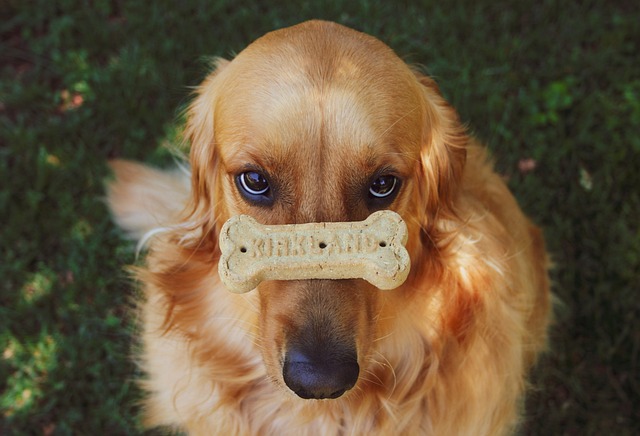
“With patience and practice anyone can learn to solve crosswords.”
I devoted a chunk of time each morning this past winter to learning a new skill: completing the New York Times crossword puzzle.
I should explain upfront that not acquiring this skill for the previous 66+ years was not a matter of happenstance, lack of time, lack of access, zip code, or any other factor commonly acknowledged barrier to opportunity to learn. Well, maybe a little bit zip code (see below).
Rather, it was a deliberate choice, a conscious decision not to engage in completing the New York Times crossword puzzle.
That conscious decision might have been a subconscious reflex related to my Boston upbringing; that is, New York = Evil. Over time, I have come to appreciate bagels, Broadway musicals, the Metropolitan Museum of Art, and a good pastrami sandwich on rye, but it took a while.
It’s also possible that my issue with the NYT crossword had its roots in college, when I began to hone my disdain for classmates whose every conversation starter came directly from the front page (and only the front page) of one New York Times section or another. That feeling was deeply ingrained by the time I completed graduate school
If I’m being honest, however, atop the list, was the sheer pretentiousness of those who regularly boasted of their prowess in completing the Sunday Times crossword – in ink.
So, even years after I developed a routine of beginning my daily morning writing sessions with other NYT word games to boost cognitive function, to delay the mental effects of aging, or simply to procrastinate, I still avoided the NYT crossword puzzle.
Old Dog, New Trick
Then one Sunday in December while waiting for my students to submit their final papers, I thought, well, I’ve already paid for the crossword, let’s give it a try. Never underestimate the power of “I’ve already paid for it” as an incentive. As I’ve written previously, one meal per day included in her rent was enough to get my widowed mother out of her new apartment, down to the dining hall for dinner, and shortly thereafter, connected with a circle of friends.
I didn’t finish the puzzle that Sunday, but I experienced enough success that I was encouraged enough to give the crossword another try. I decided to begin on a Monday, assuming that like some other NYT games the crossword increased in difficulty from Monday to Sunday*.
So, that following Monday, the first Monday of winter, Christmas week, I completed my first NYT crossword.
By the following Sunday I had a six-day streak going. I also had plenty of time to kill as I sat at my desk staring out the window at the frigid scene of a man hydro-fracking our well that had run dry sometime during Christmas night. Later that morning, as water burst forth from our well like the archetypical image of a Texas oil gusher, I completed my first NYT Sunday crossword.
Much like “I’ve already paid for it,” never underestimate the power of a streak – at least to a fairly competitive white male aging boomer. I ventured on.
Learning To Crossword
At some point early in the new year the realization struck me that solving crosswords was a skill, one in which I was slowly, but steadily, acquiring some proficiency. There were patterns. There were rules, little things to be learned. I started to compile a mental list and then a written list. For example:
- If the clue is plural, the answer probably ends in ‘S’
- If the clue is not in English, the answer is not in English
- The tense of the answer matches the tense of the clue
- Look for serious wordplay when the clue ends with a question mark
- Take clues literally, then don’t take clues literally
- Answers repeat across puzzles, sometimes with the same clue, sometimes not
- Be aware and beware of heteronyms,
In late February, I happened to scroll to the bottom of the Games page on the NYT site (the Crossword is at the top) and saw an article titled, How To Solve the New York Times Crossword. I decided to wait until my little crossword experiment ran its course before reading the article. When I did read the article, I found that all the tips I had picked up on my own were in there, plus a few more, which raised the age-old instructional question:
What, if anything, did I gain by discovering those rules on my own as opposed to being taught them in advance?
Did the sense of accomplishment in figuring out a new rule increase my engagement and success, or would I have progressed even more quickly if given that advice upfront? Is my answer to that question the same for other people?
But I’m getting ahead of myself.
It was early January and my streak was intact, I felt like I was getting better at solving the Crossword and there was tangible evidence to back up that feeling.
I had no idea, however, how to evaluate my progress or proficiency, no benchmark against which to compare my performance.
Enter Morgan Polikoff
On the evening of Saturday, January 10th, Morgan Polikoff posted the following on BlueSky:
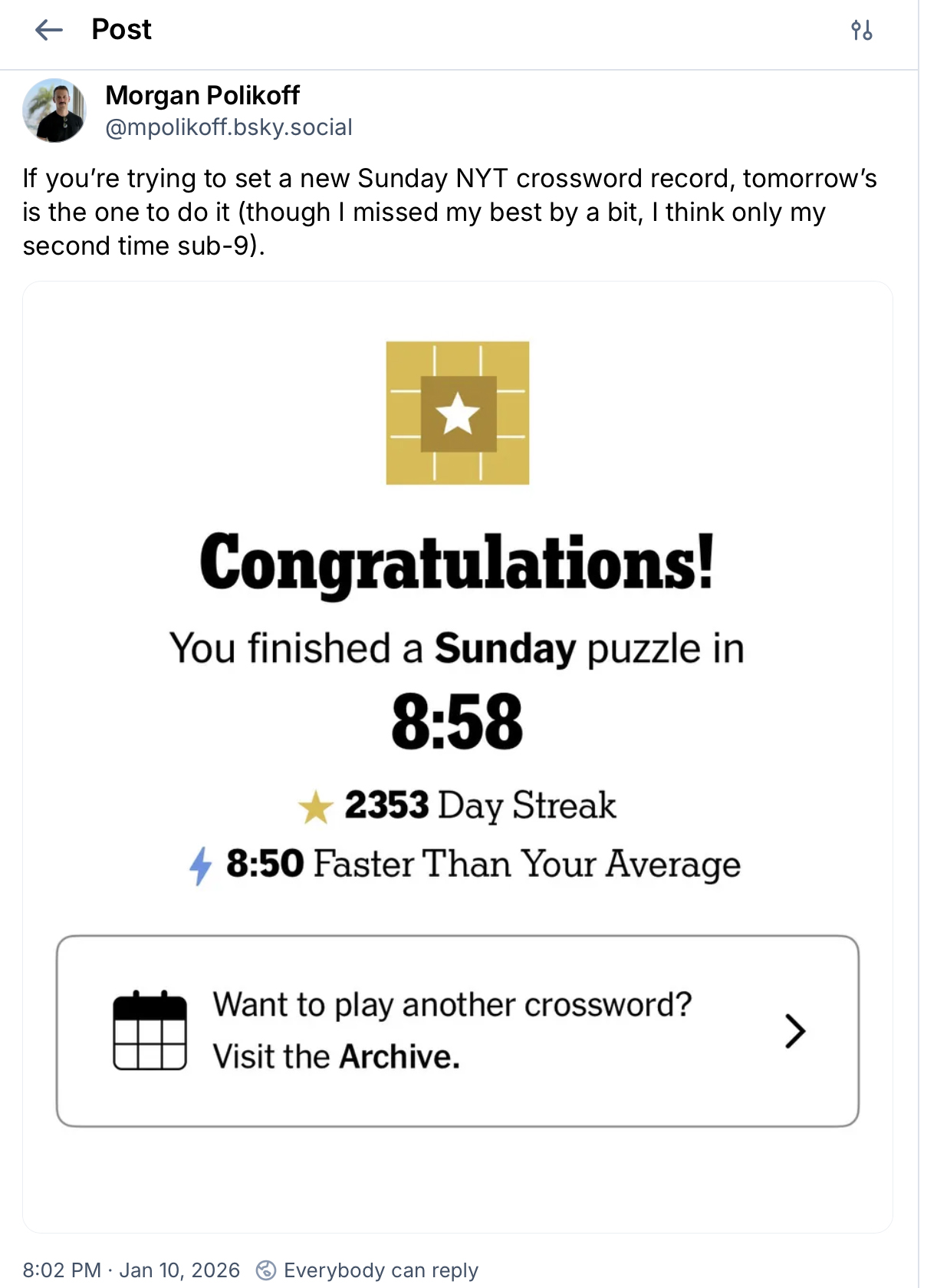
The Sunday crossword in under 9 minutes! I can barely finish reading the clues to the Sunday Crossword in 9 minutes.
A Sunday average of around 18 minutes – somewhere between my Monday and Tuesday average and a good hour faster than the time I was spending completing the Crossword on Sunday.
I could have been discouraged, but context is critical. I know that Morgan is an outlier, residing in the rarefied air of the thin end of the curve in just about everything he does, including posting on BlueSky. Why would solving the Crossword be any different?
And there was that note about his 2,353 day streak, or about 2,333 days longer than my streak at the time.
Practice makes damn near perfect, as they say. Another important lesson about learning a new skill.
Now, I didn’t really need a benchmark against which to judge my Crossword proficiency. It’s not like I was going to be graded on my Crosswording, posting my times on BlueSky or writing a blog post about learning how to crossword.
But blissful ignorance has never been my thing. With the assistance of Google’s AI helper, I learned that when it comes to completing the Sunday Crossword “average times often fall around 45-60 minutes for regular solvers” and “beginners might take over an hour” to complete the puzzle. Expert/Fast solvers (e.g., Morgan) take 10-20 minutes.
As for the easier Monday crossword, “those new to crosswords often take roughly 10-15 minutes or slightly longer.”
So, here I am, a typical beginner new to crosswords. When my streak reached 100 days at the end of March, I had invested a total of approximately 71 hours of winter mornings to the Crossword. A significant amount of time, perhaps, but <1% of the 10,000 hours supposedly “required” to attain expert mastery.
That feels about right.
I’m ready to stop solving the Crossword on a daily basis to spend more time working on my next book. But I will click on the puzzle from time to time.
Lessons Learned about Learning
At its core, learning to solve the Crossword is the same as acquiring proficiency in any other skill.
It requires practice. Lots of practice. Productive practice. We seem to discount the value of practice these days. I don’t get that.
It’s important to experience success early and on a regular basis. Scaffolding, like beginning with the Monday Crossword, helps keep you going.
I felt really good the first time I completed a Crossword in a single pass through the Across and Down clues. Feeling good is nice, of course, but it’s generally not enough.
Benchmarks are important, It makes no difference to me or anyone else whether I solve a Wednesday Crossword in 20 minutes, 30 minutes, or 3 hours. But most skills we are learning early in our lives don’t work that way.
But they must be the right benchmarks and used at the right time.
We’ll always need benchmarks and there will always be a place for norms.
I didn’t mention anything about seeking outside “help” while solving the Crossword. Apparently, there are two schools of thought on that, just as there are about the ethics of using AI to support certain skills. There is no right answer and no single answer to the question of when and how much “help” is appropriate in all contexts. There is a need, however, to agree on an answer of what is acceptable at this time in particular situations – and to agree to revisit that question on a fairly regular basis.
A final word…
If you are thinking of beginning to solve the Crossword, a bit of free advice. Familiarize yourself with the work of Etta James and Rita Ora. You won’t regret it inside and outside of your crossword activity.
And don’t stop at Rita Ora, look at pretty much any use of the word “ora” in English or other languages. Plus, throw in “oar” and “ore” for good measure, and “Oreo” too while you’re at it.
Image by Claire Diaz from Pixabay
 Embrace the Absurd
You must be logged in to post a comment.