
As July 4th and America 250! approached, I found myself thinking back 50 years to 1976 and The Bicentennial. My initial thoughts centered on how much has changed in my life as well in the country in the intervening 50 years. That list might begin with the fact that in 1976 I was typing papers on my manual Underwood typewriter while watching Red Sox games for free over the air on my 12-inch black-and-white TV.
Yes, I know that both the typewriter and TV were outdated by 1976, but such was my life and the life of many. Things seemed to change more slowly back then even as we watched men walk on the moon and tried to adjust to the designated hitter in baseball.
We did have a color TV in the den (which with its built-in china cabinet probably was supposed to be a dining room) and my parents shortly thereafter got basic cable. The Underwood, however, I used through college (and it still sits here on my desk). My sister did get an electric Smith Corona typewriter as a high school graduation present. The Brother electronic typewriter with its replaceable ink cartridges that accompanied me to graduate school was shortly thereafter replaced by my first PC – a Packard Bell – and the Volkswriter word processing program with its long list of formatting codes.
Anyway, my thoughts soon turned to US history. First, there’s 25% more of it today than there was in 1976. That thought always bothered me back in the days when I was helping states and schools design history tests. The length of the school year remained the same, but the amount of US history kept expanding. It wasn’t neatly packed like the ancient civilizations of Egypt, Greece, and Rome or the Chinese dynasties.
When I was taking US history in 1976, we used a textbook that had been published in 1964. At the end of the course, RFK and MLK were still alive, Viet Nam was still divided into North and South, the moon was a goal, and Nixon was the sweaty guy who lost the 1960 presidential election. To be fair to my beloved Boston Public Schools, in spring 1978, I did have a college professor who argued that a minimum of 25 years had to pass before people and events could be considered history. Prior to that they were merely current events. He did then spend the rest of the class giving a scathing critique of the Kennedy administration, at times giving serious Lee Harvey Oswald vibes, but I’m sure that he was just trying to prove his point.
A big part of the point he was making, which I had not considered seriously and didn’t fully grasp at the time, was not only does the body of US history continue to grow, people’s perception of and perspectives on the things that already occurred and were safely recorded in history books changes. And there were also things that weren’t included in the history books originally that deserve a second look from a second or third viewpoint. (Frankly, I feel sorry for anybody anywhere tasked today with developing a US history test, but that’s neither here nor there.)
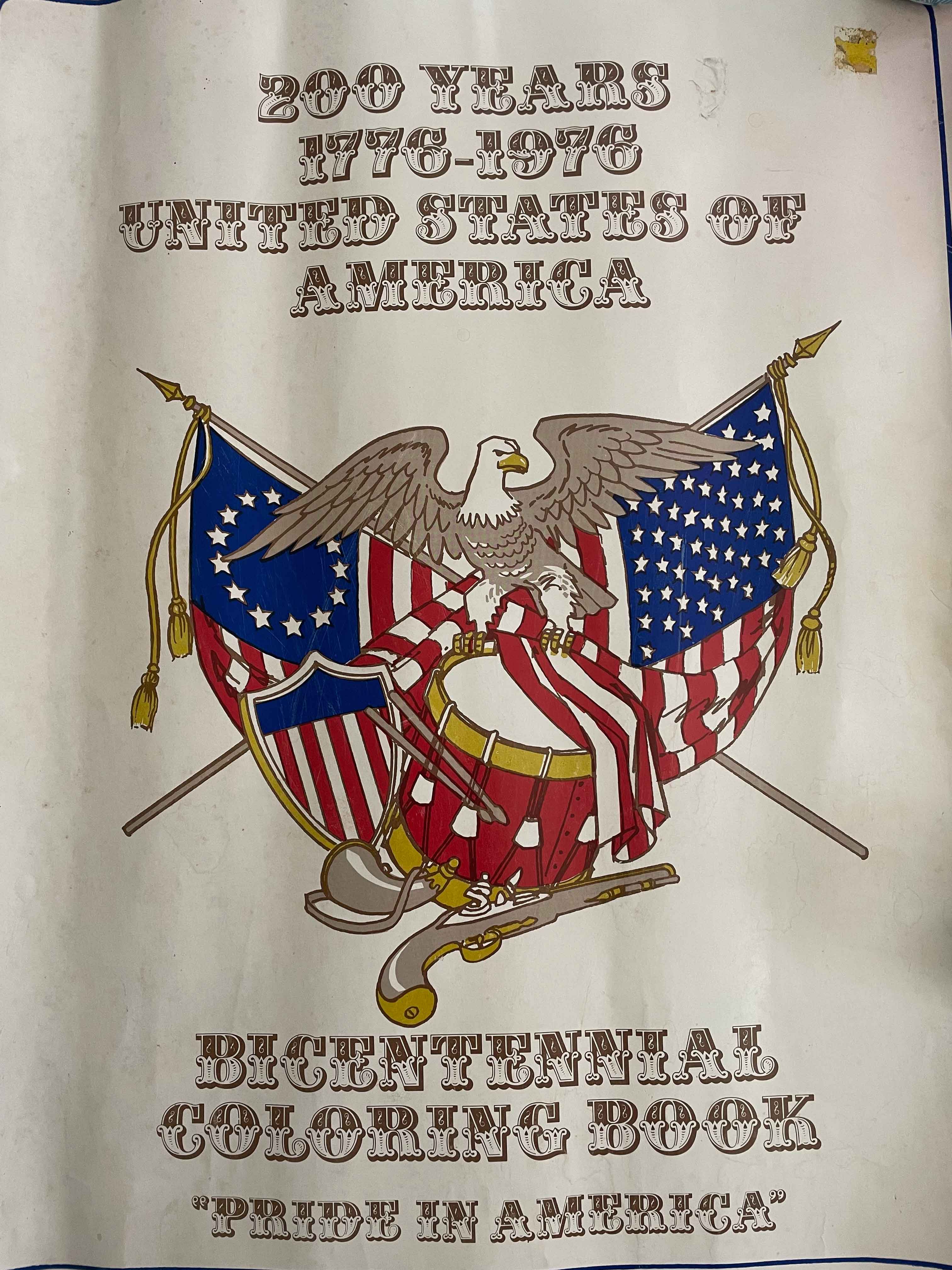
With that frame of mind, I began to wonder how would US history captured and celebrated at the Bicentennial in 1976 look different if it were written today. As a starting point on how key moments and important people in US history were portrayed in 1976, I went straight to a primary source document, my oversized 17” x 22” Bicentennial coloring book:
Now at this point, you’re probably asking yourself two questions:
- Why, as a high school junior in 1976, did I have a Bicentennial Coloring Book?
- Why, in July 2026, do I still have that Bicentennial Coloring Book?
The answer to the second question, as we have established several times over the past few years, is that I’m a hoarder. When my parents moved from Boston not too long after the Bicentennial, the unused, rolled up coloring book ended up behind the door in the room that was my room in the new house, where it stood propped against the wall until my mother sold that house in 2010. At that point, the 34-year-old coloring book was historical memorabilia, a piece of Bicentennial ephemera, no less important than my Bicentennial commemorative coins dated 1776-1976, so it made the trip up here to Maine where it sat (still rolled up) until it was time to write this blog post. (See, I knew there was a reason for keeping it.)
The answer to the first question is a little less clear, lost in the fog of 50 years, but with a fair degree of certainty, I will attribute my possession of the coloring book to my paternal grandmother and her penchant for giving age-inappropriate gifts. More often than not, it was my teenage sister who was the recipient of such gifts (e.g., gaudy plastic jewelry, a pretend make-up kit, a child’s paint-by-number set), but apparently the celebratory, historical, and really big coloring book was my turn at bat. To be fair (again), my sister was very much a teenager interested in jewelry, makeup, and art, so one might argue that her gifts were at least appropriate-adjacent. Nona’s heart was in the right place.
Back to the coloring book.
The book presents 32 events and people in close to chronological order, one picture to color per page accompanied by a brief blurb. For example, one of my personal favorites:
The Lust For Gold: A prospector “pans” for gold in the California “gold rush.” “Gold fever” developed in 1848 and caused the rapid growth of California and its admission to the Union in 1850.
So, what did Frank Aurigema of Gema Novelties, Utica, NY decide to include in his Bicentennial coloring book of American history. Listed below, in the order presented in the book, are the 32 events and people that made the cut?
The Independence of A Nation (Declaration of Independence)
Paul Revere
Patrick Henry
The Liberty Bell
Washington’s Crossing
Betsy Ross
First 13 States of the Union
George Washington
Benjamin Franklin
Francis Scott Key
War of 1812
Remember The Alamo
The Lust for Gold
Westward Ho!
The Oil Boom
The Cowboy
The Civil War
Pony Express
Transcontinental Link, Promontory Point, Utah
The Gettysburg Address
A Gift of Liberty
The Spanish-American War
The Magnificent Flying Machine
Model A Ford
Theodore Roosevelt
Woodrow T. Wilson
The American Indian
Pearl Harbor
Martin Luther King
America’s First Man in Space
John F. Kennedy
First Man on the Moon
It’s obvious that our view of the first 200 years of US history is different today than it was in 1976, even to the point of arguing about when to start the clock on America history. One might even say that the prevailing view of US history has changed dramatically.
My role here today is not to comment on the list in the coloring book.
Rather, my question to you is if you were limited to 32 historical people and events through the Bicentennial in 1976, who and what would make your cut? And what would you include in your explanatory blurbs. What is your theme? What’s the takeaway?
If you were developing a 32-item US history test or 32-week US history course, what would be included?
And keeping my professor’s 25-year guideline in mind, what would be included if we expanded US history out to 2001? And for every person/event after 1976 added, what would be dropped?
It’s not an easy task. But history is never simple or easy. Like baseball, history is supposed to be hard. Struggling through the hard is what’s necessary to make the country great.
Happy 250th America!
Header image by Jill Wellington from Pixabay


You must be logged in to post a comment.