
Every day my LinkedIn Feed is flush with posts, papers, and podcasts about the newest, freshest way in which AI is going to revolutionize educational measurement and assessment. I’ll confess that I find it all incredibly exciting and at least a small part of me wishes that I was much closer to the beginning than the end of my educational assessment journey.
But then I remember that from my time as a graduate student at the University of Minnesota in the mid-1980s almost continuously through my final Louisiana TAC meeting in 2019, I was fortunate to be involved in a series of projects, each of which at the time was considered the shiny new object, the innovation that was going to revolutionize instruction, assessment, student learning, or some combination thereof. Some of those projects began with a brilliant flash of light but dimmed over time. Some failed spectacularly shortly after launch and others never got off the ground at all. Stil others worked well with a small group of early adopters, those eager beavers we all know and love, but failed when we tried to scale up.
One or two of them even managed to survive and function for an extended period of time, decades in one case, and had a lasting impact on some aspect or detail of the way that we assess, instruct, or think about student learning. None of those innovations, however, managed to revolutionize educational assessment or instruction in the way that we had thought, believed, or hoped that it would.
My question today is why we think that the outcome will be different these AI-supported tools. Why will they succeed where others before them have failed? Already, we are seeing fierce backlash against the use of AI in the classroom. Yes, we’ve seen this type of reaction before with other technological “advances” or new educational initiatives; but calculators and new grading practices were never viewed as existential threats.
The short answer to my question is that if simply implemented the way that we have always introduced new products and interventions in education, the end result will be no different than before. Eventually, sooner rather than later in most cases, these latest shiny new objects will take their place on the shelf in the educational technology graveyard.
But what if we did it different this time?
What if we learned from past projects so that we don’t repeat the same mistakes again this time?
What if we can use AI to do it right this time, or at least to do it a lot better than we did before.
What if we can use AI to “fix the problems” or “remove the barriers” that thwarted our previous efforts?
Reflecting deeply on all of the innovative projects that I involved with in one way or another from 1984 through 2019, I have decided that the common thread that ultimately doomed each of them was a lack of attention to building and sustaining the human infrastructure needed for success.
AI and Human Infrastructure
What is human infrastructure, why is it important, and how can AI help us get it right this time?
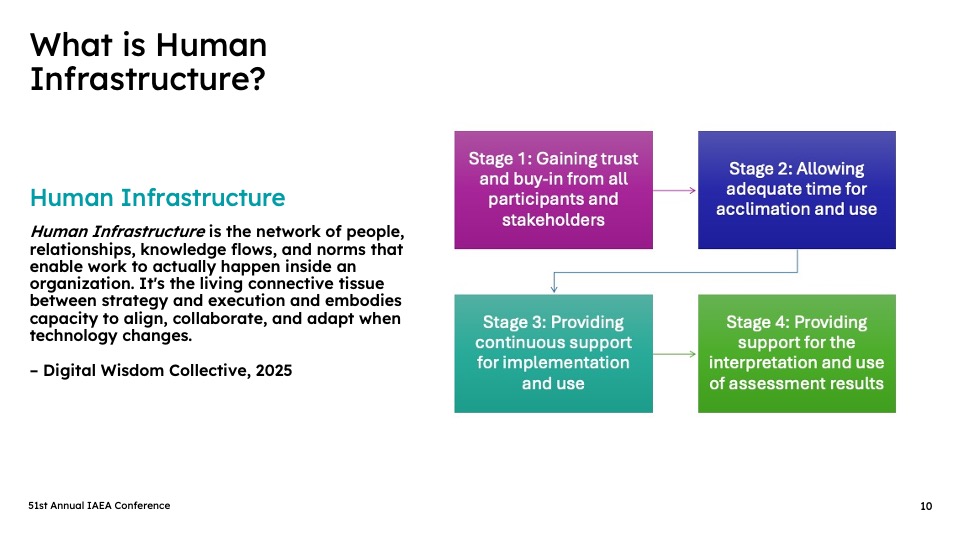
The figure above depicts four stages of building and sustaining human infrastructure: gaining trust and buy-in, time, providing continuous support for implementation, and providing support for interpretation and use.
In my experience, programs and products that fell short in the first two stages (buy-in and time) were the ones that crashed and burned immediately after liftoff or never got off the ground at all. These were the new content and achievement standards developed and implemented in a top-down manner and the on-demand state assessments that followed far too soon afterward. Sadly, there is probably not a whole lot that AI can do to help us overcome these shortcomings. Perhaps a bit with gaining trust and buy-in, but the bigger lift there will be committing to step away from a unilateral, top-down, external way of thinking about educational innovation.
The great news, however, is that in the remaining two stages – providing continuous, ongoing support for implementation, interpretation, and use – AI offers the potential to expand our capacity in ways that were never possible in the past. As recently as a decade ago, our state-of-the art solution to implementation support was hiring cadres of retired teachers to support local schools and train local trainers. With AI we can do so much more.
With regard to interpretation and use (which probably begins with (or at least relies heavily on) reporting scores and results) the ball is in our court, and the glass half full perspective is that in many ways we are working with a blank slate because we have devoted so little of our attention and resources to it in the past.
Let’s resolve to do better this time. To at least ask an AI model, or even better a teacher, student, or parent, what type of information they need to help them interpret and use the results that we are providing. Or even more better, what type of information they need that we aren’t yet providing.
It’s time for the revolution in education and educational assessment. A revolution that will be livestreamed. A revolution in which AI will allow us to finally give humans the support that they need.
Header image by Scott Webb from Pixabay


You must be logged in to post a comment.