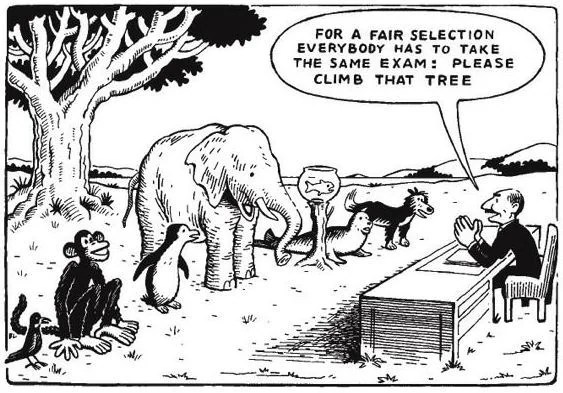
The “fish can’t climb trees” criticism of standardized testing depicted in the familiar cartoon above is experiencing something of a resurgence due to a) the dual emphasis on personalization and engagement that is all the rage and b) the flippant remark of a state Board member as New York became the latest state to eliminate its state test as a high school graduation requirement: “You don’t assess a fish on climbing a tree because fish can’t climb trees.”
In a post subtitled, The Soft Bigotry of Dumb Cartoons, Chad Aldeman reacts to the Board member’s quote and describes the slippery slope that can occur when arguments about personalization and fairness morph from flexibility with regard to how students demonstrate their mastery of required standards to holding different students to different standards. Slippery slopes, in general, are much harder to climb than trees, and like soft bigotry, are dangerous because we often don’t notice just how slippery they are until it’s too late and the damage is done. For example, it might be 15 years or more before anyone looks up from their cell phone ban long enough to notice that the decline in fourth and eighth grade NAEP scores coincides with the equally precipitous decline in the number of states with high school graduation tests. (Didn’t see that one coming, did you?)
Whether those coincident events reflect a correlation, a causal relationship between the two, or both are the result of a confounded concomitant variable is a discussion for another day and post.
What I am concerned about today and in this post is that “dumb cartoon” that been around for at least 50 years, lying dormant until like herpes it is reappears at an inopportune moment and place, triggered by some shock to the system. I find myself wondering whether there are “dumb cartoons” or just dumb interpretations of cartoons or perhaps just cartoonish educational policy informed by dumb interpretations of cartoons.
“For a fair selection everybody has to take the same exam: please climb that tree.”
According to most accounts, the cartoon first appeared on the scene in 1976. This timing meshes nicely with increased concerns about test bias (based on race and gender) and also the passing of state and ultimately federal laws related to students with disabilities. Interpreting the cartoon from an inclusion or accessibility framework, it doesn’t seem so “dumb” to offer appropriate accommodations (or even modifications) to meet the needs of students taking the test. In this context, one can easily see our animal cartoon sitting comfortably alongside the familiar depictions of the students waiting next to the unshoveled snowy ramp or those three kids peering over the fence trying to catch a glimpse of the Brewers winning their first World Series championship.
“Everybody is a genius. But if you judge a fish by its ability to climb a tree, it will live its whole life believing that it is stupid.”
By the time our collection of animals returned in the late 1990s, the education world was already figuring out how to mishandle things like Howard Gardner’s theory of multiple intelligences and, heaven forbid, learning styles. Rather than accommodations to measure the same standards fairly, we were now beginning our slide down the slope of soft bigotry that leads to interpreting the cartoon as a call for holding different students to different standards.
That more personalized different but equal abilities interpretation was hammered home in the early 2000s, when our cartoon was linked with the quote at the top of this section – a quote found in a self-help book. Like so many other quotes, it was misattributed to Albert Einstein. However, as Abraham Lincoln cautioned, “Don’t believe everything you read on the internet just because there’s a picture with a quote next to it.” And certainly, don’t base educational policy on a quote you pull from a self-help book.
Lincoln also warned us that although you can test all the people some of the time, some of the people all the time, and you can even test 95% of the people annually in grades 3 through 8 and once in high school, but amen, amen, I say to you, woe unto the person who attempts to hold teachers accountable for student performance on those tests. It was that accountability for teachers (and to a lesser extent schools) that led to the 2010 flare up of our cartoon as well as more modern, colorful, and inclusive variations of it that flood the internet and fuel the anti-testing movement today.
But is the backlash and all that anger rightly, or even really, directed at the test?
At test, after all, is only a test.
The Elephant In The Room
Reading between the lines – or in this case between the fish and the penguin – we encounter the elephant in the room.
It doesn’t take an Einstein to figure out that the lion’s share of the backlash against states tests and their use for accountability is actually directed at the conditions that cause poor student performance rather than at the tests themselves. Scratch the surface of complaints about the fairness of the test and you will find concerns about curriculum, funding, availability of resources, and the anachronistic structure of schooling itself. Add to those, complaints the long list of factors affecting student performance that are beyond the control of teachers and schools. All of these internal and external factors coalesce into the real monkey on the back of students and public education – inadequate opportunity to learn.
To be fair, the venom spewed into the fishbowl of tests and testing should be directed much more broadly. And that where a little digging into the backstory of our 1976 cartoon reveals an improbable history worthy of Mr. Peabody and Sherman. A history that first takes us back to 1940 and then takes us all the way back to 1898, where we leap forward, by jiminy, to an early episode of The Big Bang Theory. Okay dokay!
1940 – George Reavis and The Animal School
In 1940, George Reavis, assistant superintendent of the Cincinnati Public Schools, wrote and published a fable called The Animal School. Instead of standardized testing, the antagonist in Revis’ fable was a one-size-fits-all curriculum and a school in which all of our animal friends, regardless of their particular strengths, were required to take the same set of courses: running, climbing, swimming, and flying. As the animals had to double-up on courses to remediate their weaknesses their strengths suffered, engagement waned, I’m sure chronic absenteeism increased, and average (or mediocre) performance across all subject areas became the norm. In the end, the animal with the highest average named valedictorian was the slippery eel – an animal that bore a striking resemblance to the serpent who gained fame in fables past.
As it turns out, however, Reavis was not the first to offer this cautionary tale.
1898 – Amos Dolbear and An Educational Allegory
In 1898, Amos Dolbear, an inventor and physics professor at Tufts University, under the pseudonym Aesop, Jr., published An Educational Allegory in the Journal of Education (see below). Dolbear’s fable, a starker and darker version of Reavis’ adaptation, was aimed not as much at a one-size-fits all curriculum as at the educational philosophy behind such an approach. A philosophy bent on pressing every student into the same mold so that differences were minimized and students were symmetrically developed and similar for their own welfare as well as for the welfare of the community.Animals that didn’t go along or fit the mold were dealt with brutally.
In addition to offering that astute commentary on the state of public education, Dolbear may or may not have invented the telephone and wireless telegraph and noted the correlation between the rate at which crickets chirp and the ambient temperature – the discovery which ultimately earned him a fable-like storyline on The Big Bang Theory.
Our Moment In Time
Reavis’ fable was published as the United States was on the cusp of World War II and the subsequent migration to the suburbs that produced the distinctly American comprehensive high school, which for all of its faults (systemic or otherwise) and its roughly 60% graduation rate decidedly was not a one-size-fits-all model
Dolbear’s tale was published as US cities were growing at a tremendous rate and about to experience a massive influx of non-English-speaking immigrants. A period in which overcrowded public schools (some running two shifts per day) were described as focused on a factory-like cult of efficiency.
Today, the country and public education are on the cusp of a future we have not yet begun to understand. Schools, still largely following the same general structure and schedule as in 1950 while attempting to embrace personalization and meet the needs of individual students. At the high school level, personalized pathways come up against states (e.g., Massachusetts) that continue to extol the virtue of requiring a common “core” curriculum for all high school students, one that on paper leaves precious little room for personal preferences. As always, the devil, the serpent, and the eel are in the details.
Aldeman makes the case that there is a common body of knowledge and skill on which all students should be instructed, assessed, and which they should master. There is generally widespread agreement with that viewpoint. But there is insufficient consensus on what that “common core” should include or on how far, if at all, it reaches into high school. Portraits/Visions of a high school graduate paint us a picture of the end product, but to date provide little direction on how to get there. Again, devil, details, difficult questions to be answered.
As for fish, as I sat waiting for my haircut last week, I watched all sorts of fish move up, down, and all around the plant-filled aquarium. Is your conception of the construct “climbing” broad enough to include that movement?
That, my friends, is probably the easiest question we have to answer.
Dolbear’s Allegory
A long time ago, when the animal creation was being differentiated into swimmers, climbers, fliers, and runners, there was a school for the development of the animals. The theory of the school was that the best animals should be able to do one thing as well as another; and if there was an apparent aptitude in a given animal for doing one thing and an apparent inaptitude for doing other things, the time and effort should be spent upon the latter instead of the former.
If one had short legs and good wings, the attention should be given to running so as to even up the qualities as far as possible. So the duck was kept waddling instead of swimming, the pelican was kept wagging his short wings in the attempt to fly. The eagle was made to run and allowed to fly only for recreation, while maturing tadpoles were unmercifully guyed for being neither one thing nor another.
All this in the name of Education.
Nature was not to be trusted in her make up of individuals, for individuals should be symmetrically developed and similar for their own welfare as well as for the welfare of the community. The animals that would not submit to such training, but persisted in developing the best gifts they had, were dishonored, called narrow-minded and specialists, and special difficulties were placed in their way when they attempted to ignore the theory of education recognized by the school.
No one was allowed to graduate from that school unless he could climb, swim, run, and fly at a certain prescribed rate. So it happened that the time taken by the duck in learning to run the prescribed rate had so hindered him from swimming that he was scarcely able to swim at the prescribed rate, and in addition he had been scolded, threatened, punished, and ill-treated in many ways so as to make his life a burden, and he left school humiliated, and the ornithorhyncus could beat him either running or swimming. Indeed, the latter carried off the prize in two departments.
The eagle made no headway in climbing to the top of a tree. Though he showed he could get there just the same, the performance was counted a demerit, as it had not been done in the prescribed way.
An abnormal eel with large pectoral fins proved he could run, swim, climb trees, and fly a little; he was made valedictorian.

